English
 русский
 Español
 Deutsch
In modern automotive design, thermal management of the engine and related systems has become increasingly sophisticated and crucial. When you examine a vehicle's cooling system, you might find that in addition to the main water pump (or engine coolant pump), which is primarily driven by the engine belt, some high-performance, hybrid, or turbocharged models are also equipped with an auxiliary water pump.
Content
I. Definition and Basic Functions of an Auxiliary Cooling Water Pump
An auxiliary water pump is typically an electrically driven, independent component. Unlike traditional mechanical water pumps, it is not limited by engine speed and can operate independently, regulate flow, and even continue working after the engine is turned off, according to instructions from the electronic control unit (ECU).
Its main functions are:
- Providing independent and precise coolant circulation: Compensating for the insufficient cooling capacity of the main water pump under certain operating conditions (such as low speed, idling, or when the engine is off).
- Serving independent high-heat-load systems: Primarily used to cool subsystems such as turbochargers, intercoolers, inverters/batteries in hybrid systems, or independent heaters (such as PTC heaters).
II. Key Application Scenarios and Advantages
1. Turbocharger Cooling
For engines equipped with turbochargers, the Auxiliary Cooling Water Pump is crucial. Turbochargers generate extremely high heat during operation. If the engine is immediately shut off, the lack of coolant circulation can cause residual heat to carbonize the engine oil, potentially damaging the bearings.
Advantage: After the engine is shut off, the ECU commands the Auxiliary Cooling Water Pump to continue operating for a period of time, allowing coolant to continuously flow through the turbocharger and lower its temperature to a safe level. This is known as "post-shutdown cooling."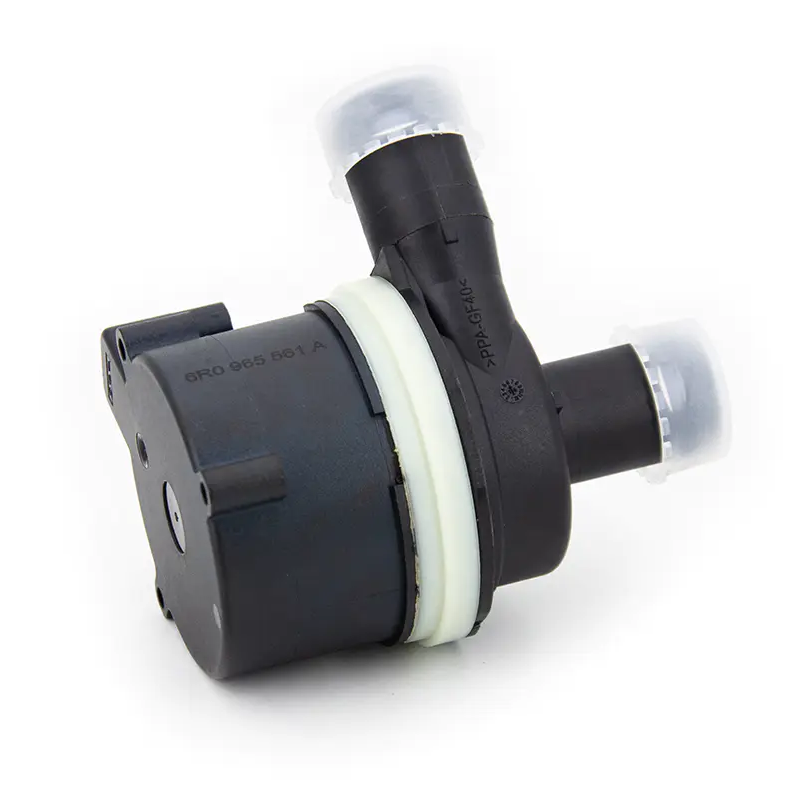
2. Thermal Management for Hybrid and Electric Vehicles
In new energy vehicles (HEV/PHEV/EV), high-voltage battery packs and power electronic components (such as inverters, DC-DC converters, etc.) must be kept within their optimal temperature range to ensure efficiency and lifespan.
Advantage: The Auxiliary Cooling Water Pump is used to drive the coolant to circulate in an independent, low-temperature cooling circuit, precisely controlling the temperature of these sensitive electronic components to prevent overheating or undercooling.
3. Independent Heating and Preheating System
In some diesel vehicles or luxury cars in cold regions, an Auxiliary Cooling Water Pump circulates coolant to additional heating devices (such as auxiliary fuel heaters) or the vehicle's radiator for rapid warm air or engine preheating.
4. Optimized Low-Speed Cooling Performance
In congested urban traffic, the engine idles or runs at low speeds, resulting in low main water pump speeds and reduced cooling efficiency.
Advantages: The Auxiliary Cooling Water Pump can be activated on demand, assisting the main cooling circuit circulation and ensuring the engine maintains its ideal operating temperature even under low load and high ambient temperatures.
III. Types and Working Principles of Auxiliary Cooling Water Pumps
Most common Auxiliary Cooling Water Pumps are electronic pumps, whose core advantage lies in their variable speed and independence from the engine.
Working Principle: It is powered by the vehicle's power supply, driving the impeller rotation via a brushless DC motor. The ECU precisely controls its supply voltage or pulse width modulation (PWM) signal based on signals from various sensors (such as coolant temperature sensors and intake air temperature sensors), thereby achieving stepless adjustment of the coolant flow rate. This precise, on-demand cooling helps reduce engine load and improve fuel economy.
The Auxiliary Cooling Water Pump is not superfluous; rather, it reflects the advancements in modern automotive technology. By providing independent and precise coolant circulation, it effectively addresses the cooling needs of high-heat-load subsystems, making it a key component for improving vehicle performance, extending component lifespan, and ensuring the stability of new energy systems.
If you see your vehicle equipped with an Auxiliary Cooling Water Pump, it means that the vehicle has more refined and intelligent control over its thermal management.